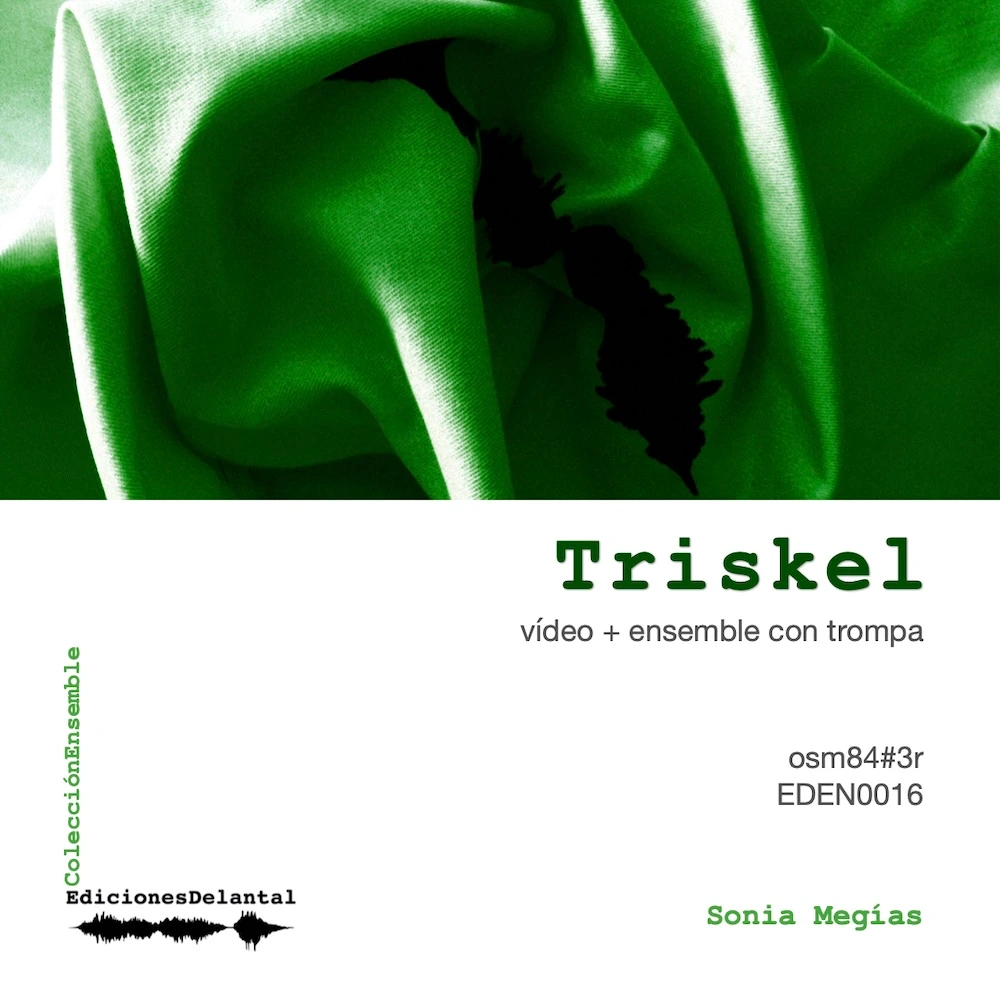
Triskel
vídeo + ensemble (fl+cl+tpa+vln+vlc+perc+pno)
Piece Triskel, for video and ensemble, osm84#3r, premiered by Ensemble Neo Ars Sonora at the Auditorio 400 of the National Museum of Contemporary Art Reina Sofía (MNCARS) in 2016.
From: Price range: 1 € through 17 € IVA incluido
Title Triskel
Catalog number osm84#3r
Series Espirales y laberintos · osm84#
Dedicated to Ensemble Neo Ars Sonora
Instrumentation vídeo + ensemble (fl+cl+tpa+vln+vlc+perc+pno)
Duration 8 min.
Written in Madrid, 2015'XII
Premiere 2016'II. Auditorio 400 del MNCARS. Ensemble Neo Ars Sonora
Level Superior
Number of pages 68
Orientation horizontal
Color Color
Publishing Refference EDEN0016
Program notes
Sonia Megías. July 2016
Triskel is the third work in my series Espirales y laberintos (Spirals and Labyrinths) (2013-, osm89#). The two previous works are Sigiloso Marte (Silent Mars), a score-instrument for a performer made in 13 boxes filled with magnesium sulfate, and Celos (Tape/Jealousy), for a group of performers who ensnare the audience in cellophane.
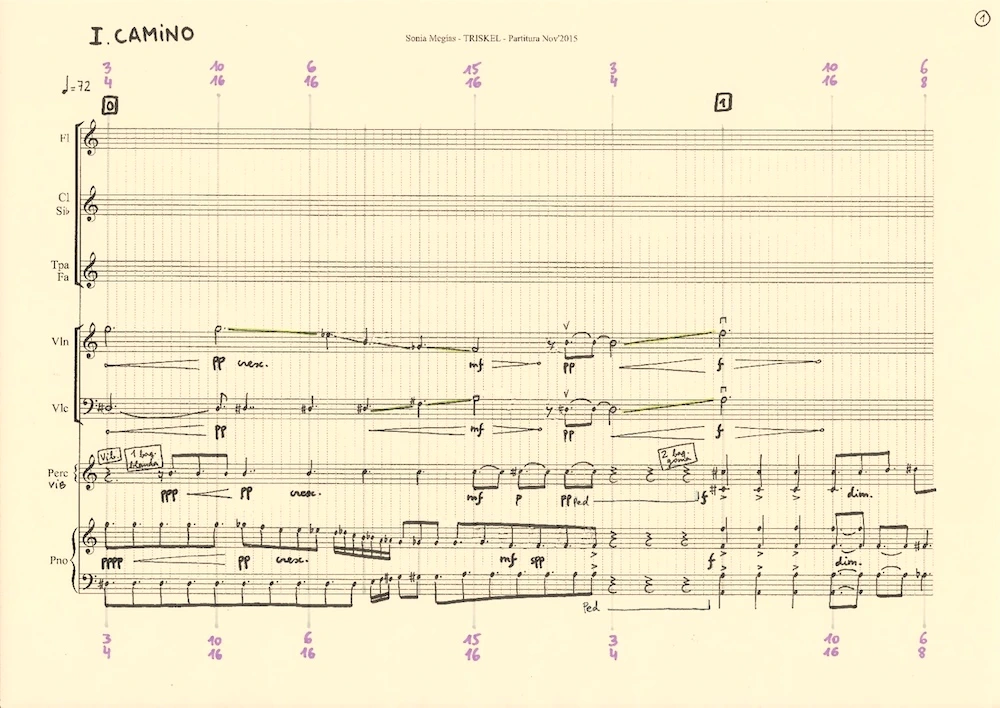
Triskel is based on the geometric figure of the triskelion, specifically an example found in the Newgrange cave in Ireland, carved in stone around 3000 BC and irregularly shaped. The compositional process consisted of transforming this bas-relief into music through 10 steps, in which the musical work was refined while the original petroglyph lost its form.
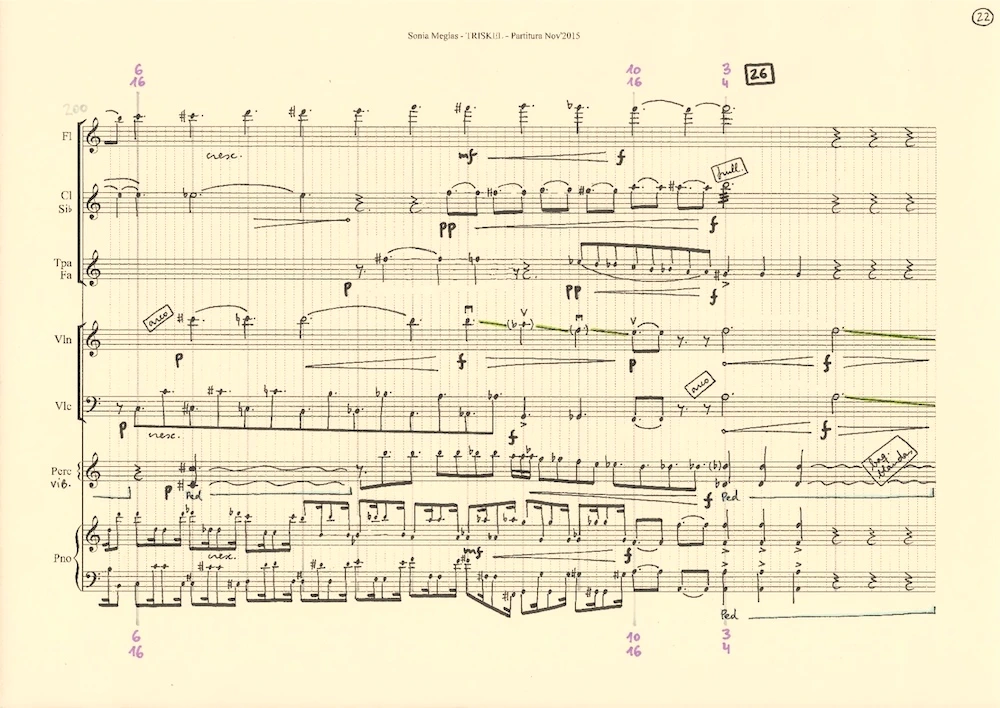
I established two coordinate axes in the photograph of the triskelion, resulting in a scale of pitches (vertical axis) and another of durations (horizontal axis). The result is, therefore, a series of chromatic variations in pitch and a gradation of durations based on the group of three quarter notes, which divides the work into 27 sections. Most of these sections begin with an explosive point that describes these three rhythmic figures, with variations according to the musical discourse. The explosive points are due to the vertical convergence of the paths. Originally, the work had no time signature, only a grid of sixteenth notes; the time signatures were added to facilitate reading for the performers.
The video of the work was prepared by Carlos Cueto, a motion graphic artist. In it, the drawing of the triskelion and its intricacies are described exactly as the score depicts them.
The piece consists of three interconnected movements:
I. Camino (path), featuring piano, strings, and vibraphone, which describes the six paths of the triskelion labyrinth.
II. Danza (dance), featuring the three wind instruments (flute, clarinet, and French horn), whose movement traces the three walls of the labyrinth.
III. Final (end), with tutti.
Triskel (2015, osm84#3) is dedicated to the NeoArs Sonora ensemble of Granada, which commissioned and inspired the work.
The version premiering at the MNCARS is written for the Sax Ensemble and substitutes alto saxophone for the French horn.
Look
Some images from the creative process:


Talk at Universidad Complutense de Madrid, and premiere at the National Museum of Contemporary Art Reina Sofía (MNCARS):


Admire
Video from the premiere, at Auditorio 400, MNCARS:
Video-art of the piece with the audio of the premiere:
Related products
-
Como la cigarra
female chorus SMA5 € IVA incluidoPurchase -
Abrazos en primavera (SATB chorus)
SATB mixed chorus10 € IVA incluidoPurchase -
SoLnatina (piano)
piano solo10 € IVA incluidoPurchase

You must be logged in to post a comment.